Centralized ID
ID-based recommendation methods trained from centralized user–item interactions.
Rethinking the attention economy through a benchmark that measures not only what people click, but how deeply recommended content develops information.
1 Australian Artificial Intelligence Institute, University of Technology Sydney
2 Evidence and Research, Department of Health, Disability and Ageing

SCOPE-Bench is open to researchers working on recommendation beyond engagement-only objectives.
Driven by the attention economy, short-video Recommender Systems (RSs) are primarily optimized to maximize user engagement by promoting videos that capture attention within seconds. These systems inherently favor shallow-content videos that are effective at attracting immediate attention. However, growing evidence suggests that prolonged exposure to such content may negatively affect users' cognitive engagement and mental well-being, raising concerns about the long-term societal impact of the short-video platform.
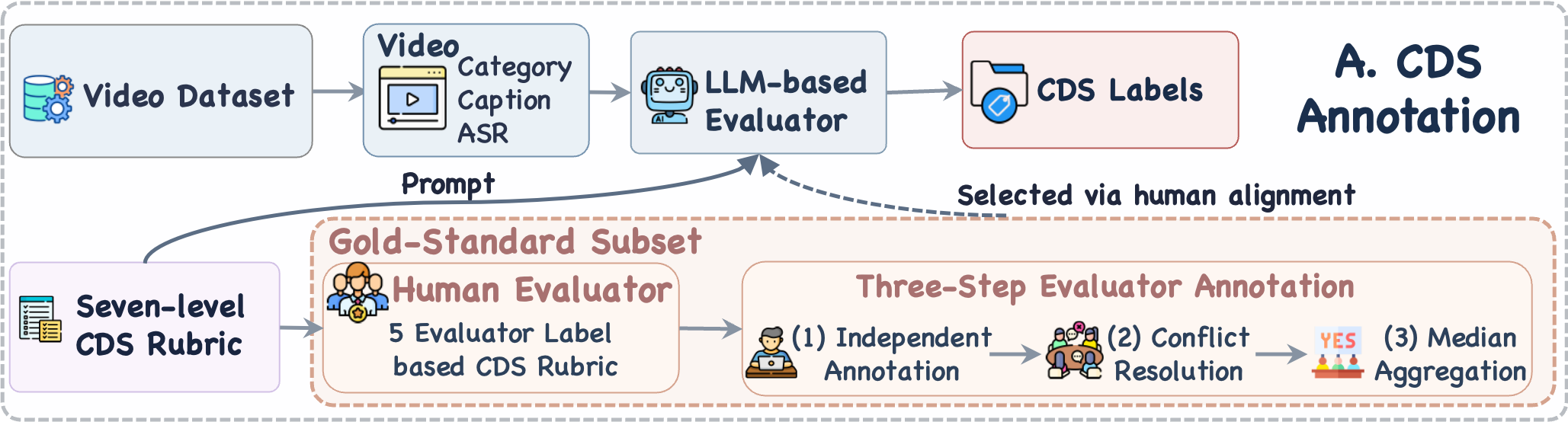
To tackle this challenge, this paper introduces a new metric, the Content Depth Score (CDS), to quantify the content depth of short videos. CDS measures the extent to which a video is expected to stimulate higher-order cognitive processes, using a seven-level scale grounded in established theories of cognitive psychology and learning. As an initial step toward this vision, we present SCOPE-Bench, the first benchmark for content-depth evaluation in short-video recommendation. Built upon a large-scale open-source short-video dataset, SCOPE-Bench provides CDS annotations for 150K videos, enabling systematic evaluation of RSs from a cognitive-content perspective.
Leveraging SCOPE-Bench, we evaluate 13 representative RSs and reveal a consistent preference for shallow-content videos. Moreover, we find that these algorithms recommending cognitively deep content are only marginally better than random selection, highlighting a previously overlooked limitation of existing recommendation objectives.
SCOPE-Bench is a paper project, a runnable benchmark and an extensible model library. Pick the path that matches what you need.
Install the benchmark and evaluate one model with unified relevance and depth metrics.
→ Get startedFor understandingExplore the benchmarkSee how CDS and LCDS connect video-level content analysis to top-k recommendation.
→ Read the overviewFor comparisonBrowse the modelsCentralized, multimodal, federated and sequential implementations in one registry.
→ View model coverageAt the item level, SCOPE-Bench assesses the content depth of individual short videos from the user perspective.
At the recommendation-list level, it evaluates the content depth of recommendation lists from the platform perspective

The repository separates centralized and federated learning by input modality, alongside sequential recommendation, under one evaluation contract.
ID-based recommendation methods trained from centralized user–item interactions.
Methods trained centrally with user–item interactions and multimodal content features.
ID-based recommendation methods optimized across distributed clients.
Federated methods combining distributed interactions with multimodal content features.
Sequence-aware recommendation methods that model ordered user interaction histories.
Select a model and dataset, then receive engagement and content-depth metrics in the same result files.
Read the complete tutorial →# install
$ git clone https://github.com/LiweiDengDavid/SCOPE-Bench.git
$ cd SCOPE-Bench
$ pip install -e ".[torch,multimodal,hpo]"
# train and evaluate
$ python main.py \\
--model LightGCN \\
--dataset ShortVideoSampled \\
--gpu_id 0SCOPE-Bench will continue to grow with new research, artifacts and evaluation capabilities. Follow the repository for future updates.
@misc{deng2026contentdepthmattersshortvideo,
      title={Content Depth Matters in Short-Video Recommendation: Rethinking the Attention Economy},
      author={Liwei Deng and Jing Jiang and Zhiwei Li and Yang Wang and Guodong Long},
      year={2026},
      eprint={2608.13990},
      archivePrefix={arXiv},
      primaryClass={cs.AI},
      url={https://arxiv.org/abs/2608.13990},
}